

We often tell our kids to be kind.
To stay curious.
To love their neighbors.
But how often do we actually teach them how to do that in the small, everyday moments?
The world our kids are growing up in emphasizes independence: figuring things out on your own, becoming self-sufficient, not needing help. And while there’s value in that, we don’t talk nearly enough about interdependence —the ability to engage, communicate, and connect with other people.
In raising my three daughters, I’ve found that the most meaningful teaching moments aren’t the big ones. They’re the ordinary, often overlooked moments of everyday life. Those small moments are the ones where connection is practiced.
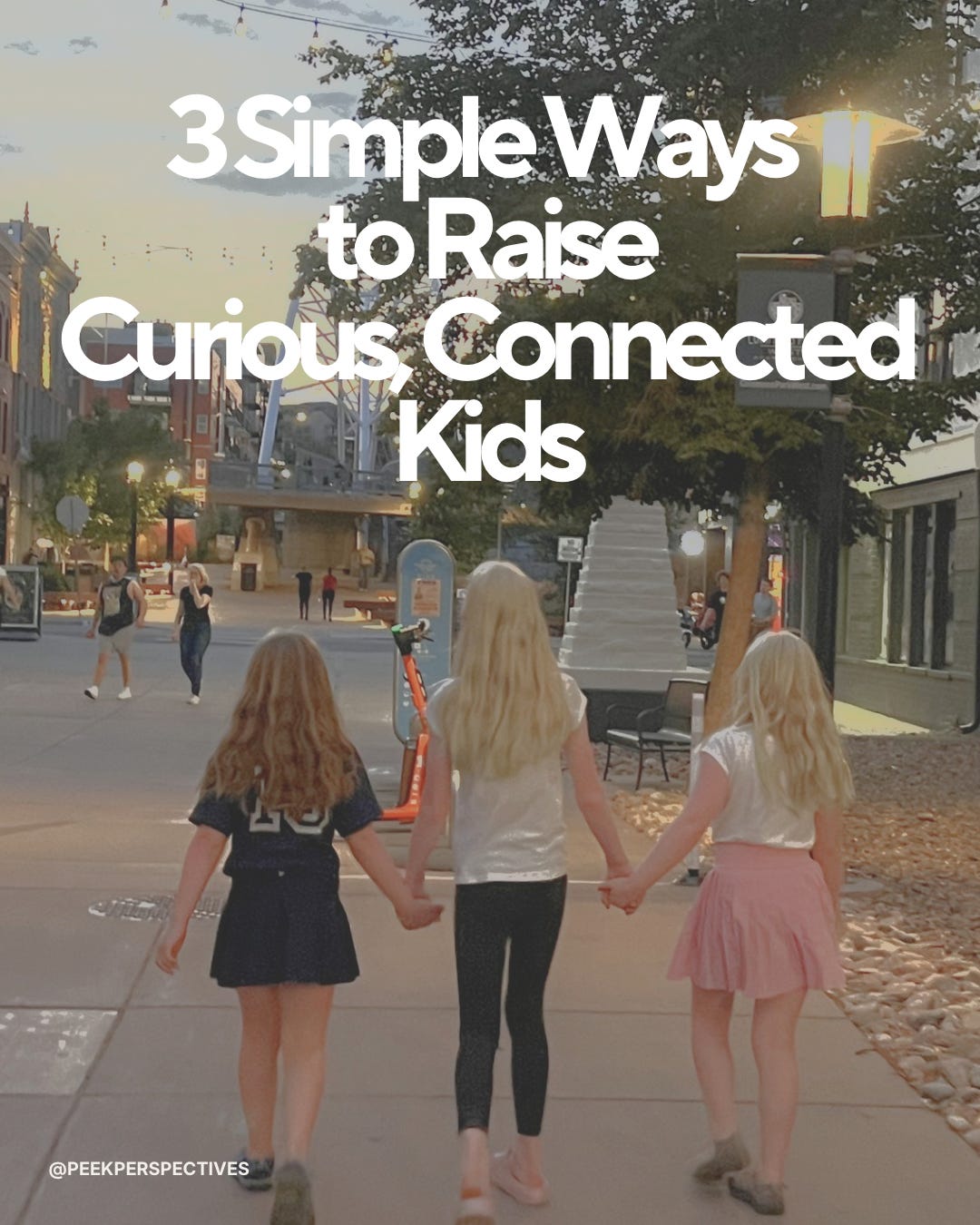
Here are three simple ways I’m helping my kids build real, human connection skills.
1. Let Them Order for Themselves
One summer, our family started a simple rhythm: eating at the same restaurant one Sunday a month after church.
It became more than just a meal. It became practice.
We would sit with our girls and look over the menu together. We’d help them decide what they wanted, and then we’d practice how they would say it. Simple things: making eye contact, speaking clearly, saying “please” and “thank you.”
And then came the moment.
When the server walked up, they looked to my husband and me… but instead, they were met with a tiny, confident voice from across the table:
“May I please have fettuccine Alfredo with chicken? And a side of grapes and French fries, please?”
Every time, the reaction from our server was the same: surprise, followed by delight.
Because it’s rare. (But it doesn’t have to be.)
Whether it’s a sit-down restaurant, a fast-food counter, or even practicing at home, the goal is simple:
Help your kids make a decision, practice what to say, and then give them the opportunity to speak for themselves.
Teaching connection in the small, safe moments can lead to courageous connection in the bigger human moments.
2. Teach Them How to Use a Phone (the Old-Fashioned Way)
Not texting. Not apps. Not FaceTime. (They probably already have those mastered!)
Teach them how to have an actual conversation, using their voice, when they can’t see the person on the other end of the line.
There was a time when calling a friend meant not knowing who would answer. A parent? A sibling? A grandparent? You had to be ready to introduce yourself, explain why you were calling, and ask for what you needed.
That skill is quietly disappearing.
Recently, my daughter left her glasses at her dance studio one evening after rehearsal. When she realized it the next day, she asked if I could call to check for them.
I didn’t.
Instead, I walked her through it. We looked up the number together. She dialed. She spoke.
A week later, an instructor from the studio pulled me aside to say how impressed they were that my daughter had called on her own. In all their years working there, it was rare even for older kids to make that kind of call themselves.
It struck me again:
Something so simple…is actually something significant.
Teaching our kids to use their voice to initiate, to ask, to communicate, builds confidence and connection in ways screens never will.
3. Help Them Connect with Neighbors
There was a time when borrowing a cup of sugar or an egg from a neighbor wasn’t unusual. It was normal.
You knocked on the door. You asked. You said thank you. And next time, you returned the favor.
Now in the age of convenience, you can pick up your phone and have the needed item on your doorstep in no time.
For many families today, the kind of interaction that requires asking for a favor feels rare or even uncomfortable. But when we remove those opportunities, we also remove a powerful space for connection. If you have a neighbor you know and trust, invite your kids into that relationship.
We have a neighbor who’s a rancher. Sometimes he brings home baby lambs to bottle feed, and over time, our girls have grown comfortable asking if they can come help.
Sometimes I’ll send them next door to borrow a tool or return something we’ve used. Instead of ordering a tool online to be delivered the next day, or even a random cooking ingredient I could grab from the store, we’ve gotten into the habit of asking our neighbor. Funny enough, it opens the door for them to do the same.
It’s simple. It’s old-fashioned. And it’s incredibly formative.
Learning to engage with people outside of our immediate circle—people of different ages, backgrounds, and experiences—is how kids begin to understand the world beyond themselves. (It’s also a reminder for grownups that we don’t need to have all the answers ourselves…)
The world our kids are growing up in looks very different than the one I grew up in… on so many levels. I am amazed at the tools they have right at their fingertips, ones I could have never imagined if you would have told me about them wayyyy back in the 1900s.
I also notice that with the advancements in technology and convenience, we are losing the art of human connection. We may be more connected with the world through technology, but we are also disconnected from the humans around us, more than ever.
The good news is, it doesn’t have to be either/or. We just have to be more intentional about teaching connection in the small everyday moments.
What are some practical ways you teach your kids about human connection? I would love to hear your tips in the comments!
Small moments build connected kids. Connected kids become compassionate adults.
Cheering you on in the small moments of connection,
Leigh