

I thought the ducks were ridiculous.
You know the ones I’m talking about. The bright, rubber ducks that adorn the dashboard of a Jeep Wrangler that is parked next to you in a parking lot. Rubber ducks that you might find in your child’s bath toy collection, sitting on the dashboard of a rugged vehicle known for off-roading? It honestly just seemed absurd. I have wanted a Jeep for as long as I can remember, and I finally bought my dream version the year I turned 40. But ducks on my dashboard?! I would never.
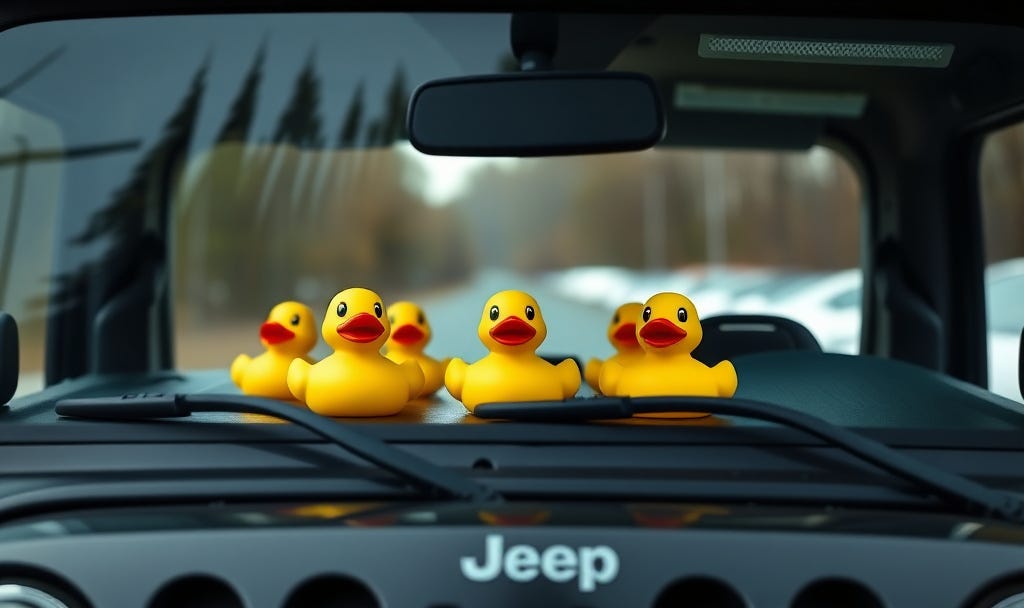
Then one day, someone ducked my Jeep.
I hadn’t been a Jeep owner for very long, when I came out of a restaurant to find a yellow rubber duck tucked into the driver’s side door handle of my previously un-ducked Jeep. A small note accompanied the duck, wishing me a great day.
My girls were delighted.
I was…conflicted.
I didn’t expect it to matter. But somehow, it felt unexpectedly personal and kind. A stranger, somewhere in the parking lot, had seen my [duck-less] Jeep and taken a second to acknowledge me. They would never know if I gave the duck to my children for their bath toy collection or whether it would end up on my dashboard. They simply recognized a small thing we had in common, no matter how different our actual lives may be.
That night, I went home and started reading more about this odd tradition.
The more I learned, the more my perspective changed.
In 2020, at the height of the COVID-19 pandemic, a Jeep owner in Canada started the trend as a random act of kindness to make someone smile. It went viral. In a time when the world was socially distancing and desperate for human connection, the simple act of leaving a rubber duck on another Jeep became a symbol of acknowledgement. A moment that said, “I see you. I appreciate our shared interest. I like your Jeep.” The practice, now known as “Duck, Duck Jeep,” is a widespread phenomenon among Jeep owners (especially Jeep Wranglers), and a note sometimes accompanies the gifted duck.
Suddenly, what had looked silly from the outside felt deeply human from the inside.
I started noticing ducks everywhere. While in NYC on a girls’ trip later that year, I saw a special edition Lady Liberty duck at a souvenir counter. It caught my eye, but I didn’t buy it. (That one surprised me by showing up under my Christmas tree, a gift from my sister... my 2nd duck.)
At first, it was a novelty. But month after month, random rubber ducks would show up on my dashboard, on my windshield wipers, stuck in my door handle, at a random gas station, at a restaurant, and even at a ski resort where I vacationed with my family. Eventually, it became symbolic. Each randomly discovered duck communicated, “I see you. We share something in common.”
There’s simply something about feeling seen by a stranger, especially one who doesn’t ask anything of you. Humans crave recognition and connection, and it turns out that we don’t actually need to know the whole story about another person to feel connected. In fact, we only need to recognize our shared humanity. And shared humanity often begins with one small point of common connection.
Another fun thing about the Jeep community is the signature “wave.” This wave is a long-standing tradition of camaraderie, where passing Jeep drivers acknowledge each other with a simple hand gesture that looks like a peace sign. 2 fingers lifted from the steering wheel is all it takes to display mutual respect and community.
I no longer live in a very small town, but driving around in my Jeep now reminds me of the days back in my hometown, where everyone waved to everyone. I once had a college roommate accompany me back home to visit my family. She was from a large city, and she was confused by my wave to every passing car while we cruised Fir Avenue, the main street passing through my hometown. “Do you actually know every car we pass? I know it’s a small town, but….” I explained that it wasn’t deep familiarity (although I probably did know most of the people passing by); it was simple acknowledgement, part of the culture in the town where I grew up.
I find that I see Jeeps everywhere…because now I’m looking for them. I have more Jeep “friends” around this world than I know what to do with. But I wave at every single one.
This makes me wonder about life outside of the road.
What if we looked for shared humanity everywhere, the way my mind subconsciously searches for fellow Jeeps?
What if we intentionally looked for people to acknowledge? What if we stopped waiting to decide whether we knew enough “facts” to agree with someone, before extending kindness?
In our workplace. In parenting. In politics. In neighboring. Online.
What if shared humanity doesn’t require agreement or details? Maybe it simply begins with acknowledgement.
A rubber duck on a dashboard may seem insignificant, until you realize what it represents: one human reminding another human, “You’re not invisible. I see you.” The older I get, the more I think people are desperately searching for that simple message: “I see you.”
Maybe the world doesn’t change only through major acts of influence. Maybe it changes through small moments of recognition in everyday encounters — a wave from a passing driver, a rubber duck on a windshield, a pharmacist learning a patient’s story, a neighbor choosing curiosity over assumption.
Maybe that’s where shared humanity begins.
-Dr. Peek
Challenge: Look for one opportunity this week to acknowledge someone who may feel unseen. Bonus points if it’s someone who isn’t already a friend. Maybe it’s a neighbor you’ve avoided due to political differences. Maybe it’s the cashier in the checkout line. Maybe it’s a patient in clinic who is often difficult. Maybe it’s a coworker who you don’t know well. The point is that you don’t need more information or more time… shared humanity doesn’t require it. Ask a followup question about their life. Find a shared point of connection, and point it out. No matter how small it may be. (No ducks required.)